Build Guide
Composite, cedar, or treated
The material argument reads differently in a valley that runs a long clear summer at elevation. What each of the four realistic options costs, what it demands, and how it ages in this specific climate.
Meridian sits high and dry, in a cold semi-arid climate. NOAA's 1991 to 2020 normals for Boise give a July average high near 93 degrees and a January average low around 25 degrees. That combination, a long bright dry summer and a real freezing season, is what should drive the material decision here, more than any brand comparison.
The four realistic options
Pressure treated pine
Softwood, usually southern yellow pine, infused with preservative under pressure. It is the framing material under every deck regardless of surface, and it is the cheapest surface too, at $32 to $48 per square foot installed.
Its weaknesses in this climate are movement and finish life. Standard wet treated stock arrives with a lot of moisture in it and can cup and twist through its first summer as it dries down hard. Kiln dried after treatment lumber costs more and moves considerably less, which on a deck surface is worth the difference. Either way it wants a clean and re-coat every two to four years here.
Western red cedar
Naturally rot resistant, dimensionally stable, and the nicest of the four to stand on barefoot in August because it runs cooler than treated pine and much cooler than dark composite. $42 to $66 per square foot installed.
Cedar takes a semi-transparent stain evenly rather than blotching, which matters because pigmented finishes are what protect wood from ultraviolet degradation. Being close to the Pacific Northwest supply chain, standard cedar decking sizes are stocked across the Boise metro trade rather than special ordered. Wide boards and clear grades are the exception and add lead time.
Capped composite
A wood flour and polymer core with a hard polymer cap bonded to the exposed faces. $55 to $88 per square foot installed. The cap is the whole point: uncapped composite from twenty years ago faded and stained badly, and the capped generation does not.
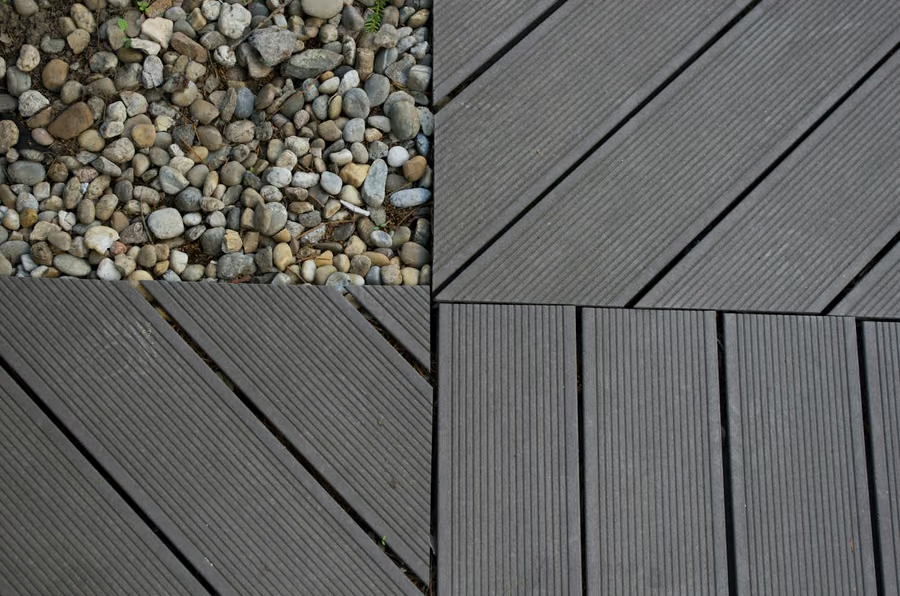
The catch is framing, and it is a mechanical one. A composite board is stiffer than wood in some directions and considerably less stiff in others, and it creeps under sustained load in a way timber does not, so it wants more support beneath it than a wood board of the same size. Every manufacturer publishes what its own product needs, and that document governs.
This is why re-boarding an old frame in composite is rarely the cheap upgrade it looks like. A frame built decades ago for thick wood decking was designed around a board that carried itself between supports. Laying a composite board on it, especially on a diagonal, asks for supports the frame does not have, and the fix is new timber threaded in alongside the old.
Capped PVC
Fully synthetic, no wood content. $66 to $105 per square foot installed, the most expensive option. Lighter than composite, generally the best performer on heat gain and on moisture, and the choice where a deck sits in full west-facing sun with no prospect of shade.
Where the money goes
Over twenty years the comparison narrows further. A wood deck wants cleaning and re-coating every two to four years, at $1,400 to $3,200 a time on a typical deck. Call that six or seven cycles across two decades. Composite absorbs that cost up front instead of spreading it, which is why the material argument lands harder on a house someone intends to keep than on one they plan to sell in three years.
Heat underfoot
This is the complaint that comes up most in this valley and it is about color, not brand. Dark boards in full afternoon sun on a 95 degree July day are uncomfortable barefoot, and that is true of dark stained wood as well as dark composite. Lighter grays and tans run noticeably cooler. Some PVC products are engineered specifically for lower heat gain.
If the yard faces west with no shade, the two workable answers are a light color or a cover. Both are cheaper than replacing a deck nobody uses after two in the afternoon, and the shade guide covers the second.
How each one ages here
- Treated pine, unmaintained. Silver-gray in two summers, surface checking by year three, and the checks are what let water in. Structurally sound long after it looks bad.
- Cedar, unmaintained. Grays more gracefully and stays flatter, but the same ultraviolet degradation is happening. Cedar rewards maintenance more than treated pine does because the underlying board is worth protecting.
- Capped composite. Holds color. Manufacturer warranties commonly run 25 to 50 years on the boards with shorter separate terms for fade and stain, and those warranties pass to the homeowner with the paperwork.
- Capped PVC. Similar, with less thermal expansion drama and a slightly more synthetic look up close.
One thing applies to all four: the frame underneath is pressure treated lumber, and it is the frame, not the surface, that sets the real service life of a deck. A composite surface over a badly flashed ledger is the worst trade available, because the expensive part outlives the cheap part that fails.
A reasonable way to decide
If the deck is a fix before selling, treated pine is fine and the money is better spent elsewhere. If it is a twenty year feature on a house you intend to keep, composite usually wins on total cost and certainly wins on Saturdays. If it is somewhere you will sit barefoot in August and you care how it looks, cedar is the one people love and the one that asks something of you every few years.
Price two of them side by side on your own footprint with the cost estimator, and read the finishing guide before committing to wood, because that maintenance cycle is the part people agree to without quite realizing.
Keep reading
Ready for a number on your own yard? Call (208) 314-4914 or use the quote form for a free quote.
Related questions
Does composite decking really never need maintenance?
Which material handles Idaho winters best?
Can I mix materials?
Thinking about a deck this season?
Call (208) 314-4914 or use the quote form for a free written price on any deck project in the Treasure Valley.